You Can’t Pour From an Empty Cup: Why Business Owners Need a Smarter Health Strategy
Business wellbeing and business performance go hand in hand. Find out how pain, stress, nervous system strain, and poor recovery impact business owners, and why having a smarter health strategy is important.
Written by Gary Wagner
Founder and Head Coach, Recalibrate Personal Training
Specialist Personal Trainer for the Forty+, Injured and Time-Poor
Moorabbin, Melbourne | Online Coaching Australia-wide and internationally
Business owners love talking about resilience.
We talk about grit, leadership, consistency, productivity, growth, strategy, cash flow, client service and long-term vision.
But too often, the person driving the business is physically running on fumes.
The body gets stiff. The back tightens. The neck locks up. The shoulders sit somewhere near the ears. The hip starts complaining. The elbow starts aching for no obvious reason. Sleep becomes lighter. Energy drops. Decision-making gets harder.
And the business owner keeps going, because that is what business owners do.
Until eventually, the body starts sending louder signals
That is why the phrase “you can’t draw from an empty cup” matters in business. It is not simply a motivational quote. It is an operational reality.
If your body, nervous system, recovery, pain levels and executive function are under constant pressure, your business leadership will eventually pay the price.
Workplace research regularly links wellbeing, presenteeism, absenteeism and productivity. SafeWork Australia notes that sickness absence and presenteeism directly affect organisational productivity, while psychosocial safety and psychological health influence disengagement, absence, and lowered performance. (Becher & Dollard, n.d.)
For business owners, the issue is even more personal.
Because when you are the owner, leader, decision-maker, salesperson, problem-solver and often the emotional container for everyone else, your health is not separate from the business.
It is part of the business infrastructure.
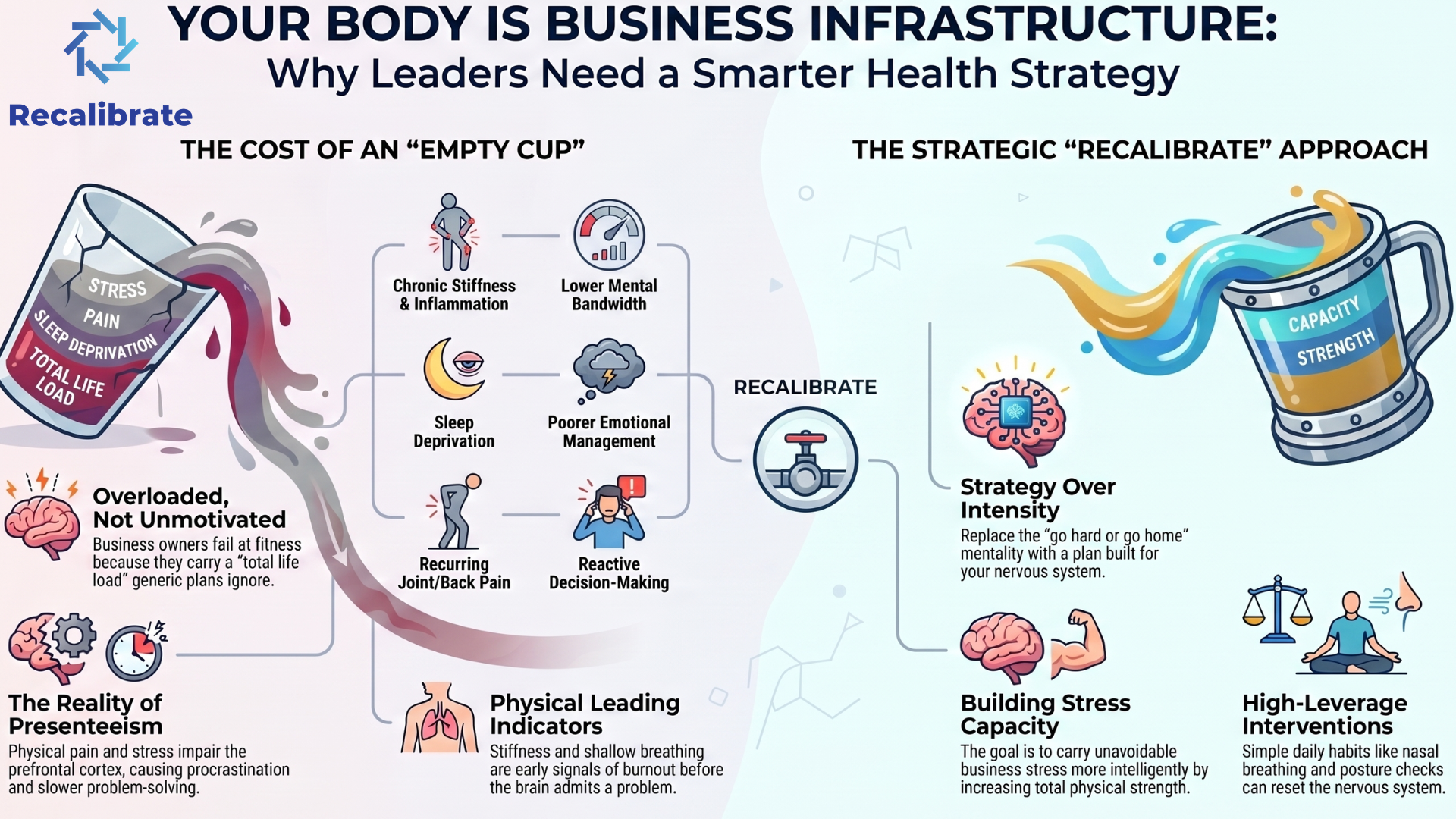
Business owners are rarely unmotivated.They are overloaded.
One of the biggest mistakes in the health and fitness industry is assuming that busy professionals and business owners are simply lacking motivation.
In my experience, that is usually wrong.
Many of these people are among the most motivated, disciplined and capable you will meet. They can build a business, lead a team, serve clients, solve complex problems and push through pressure that many people would avoid.
The problem is not motivation.
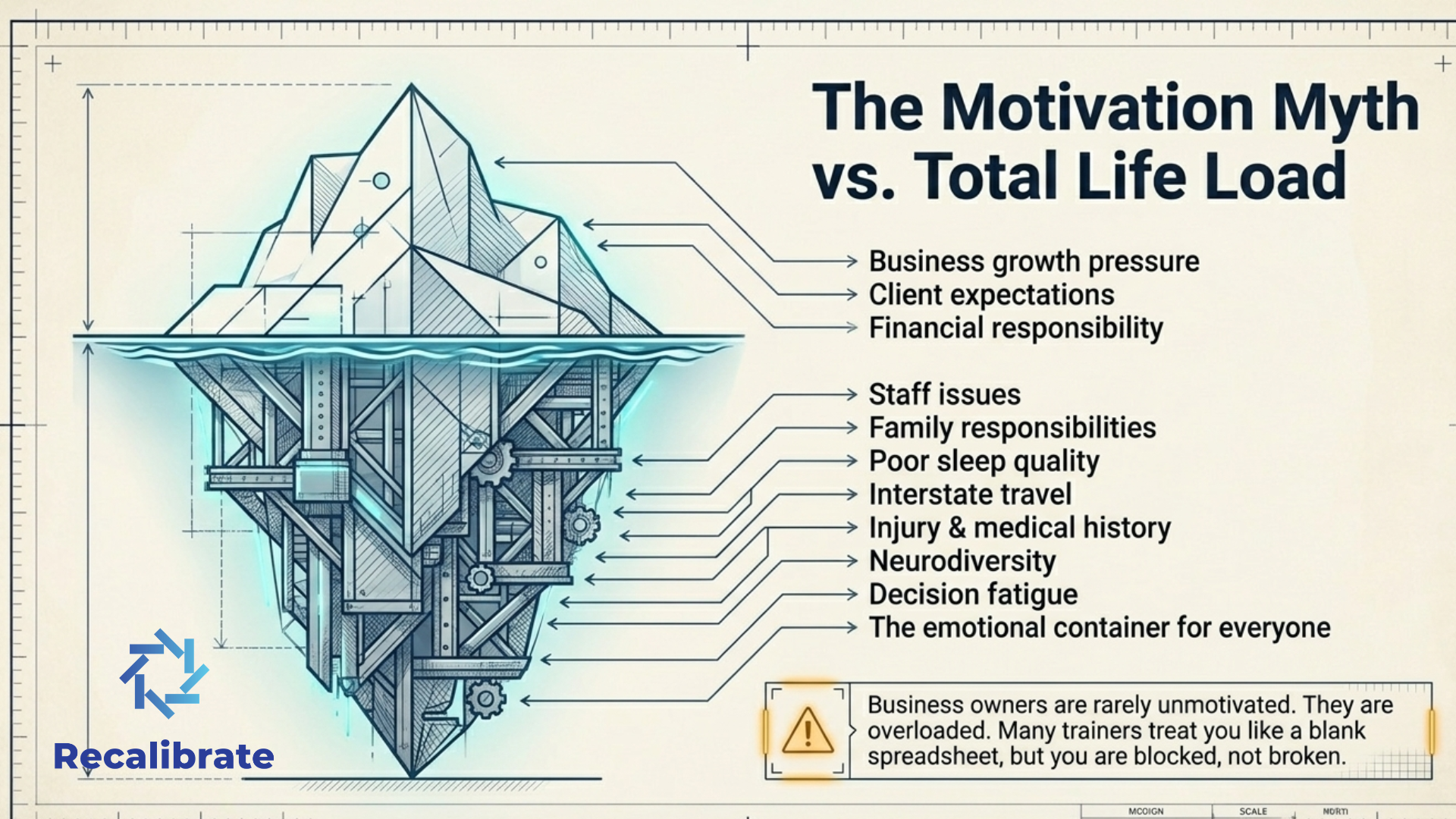
The problem is the total life load.
A business owner may be carrying:
- business growth pressure financial responsibility
- staff or contractor issues
- client expectations
- family responsibilities
- poor sleep quality
- time in the car or interstate travel
- injury history
- medical history
- neurodiversity
- decision fatigue
- irregular nutrition
- alcohol or medication used as coping support
- the emotional pressure of being “the person everyone relies on”
Then they walk into a gym and are treated like a blank spreadsheet.
The trainer sees a body that needs to lose weight, get stronger or “be more disciplined”. They often miss the person behind the body.
That is where generic advice breaks down.
This is why I often say many clients are blocked, not broken especially when they are over 40, dealing with pain, and carrying more life load than their old training plan was ever meant to handle.
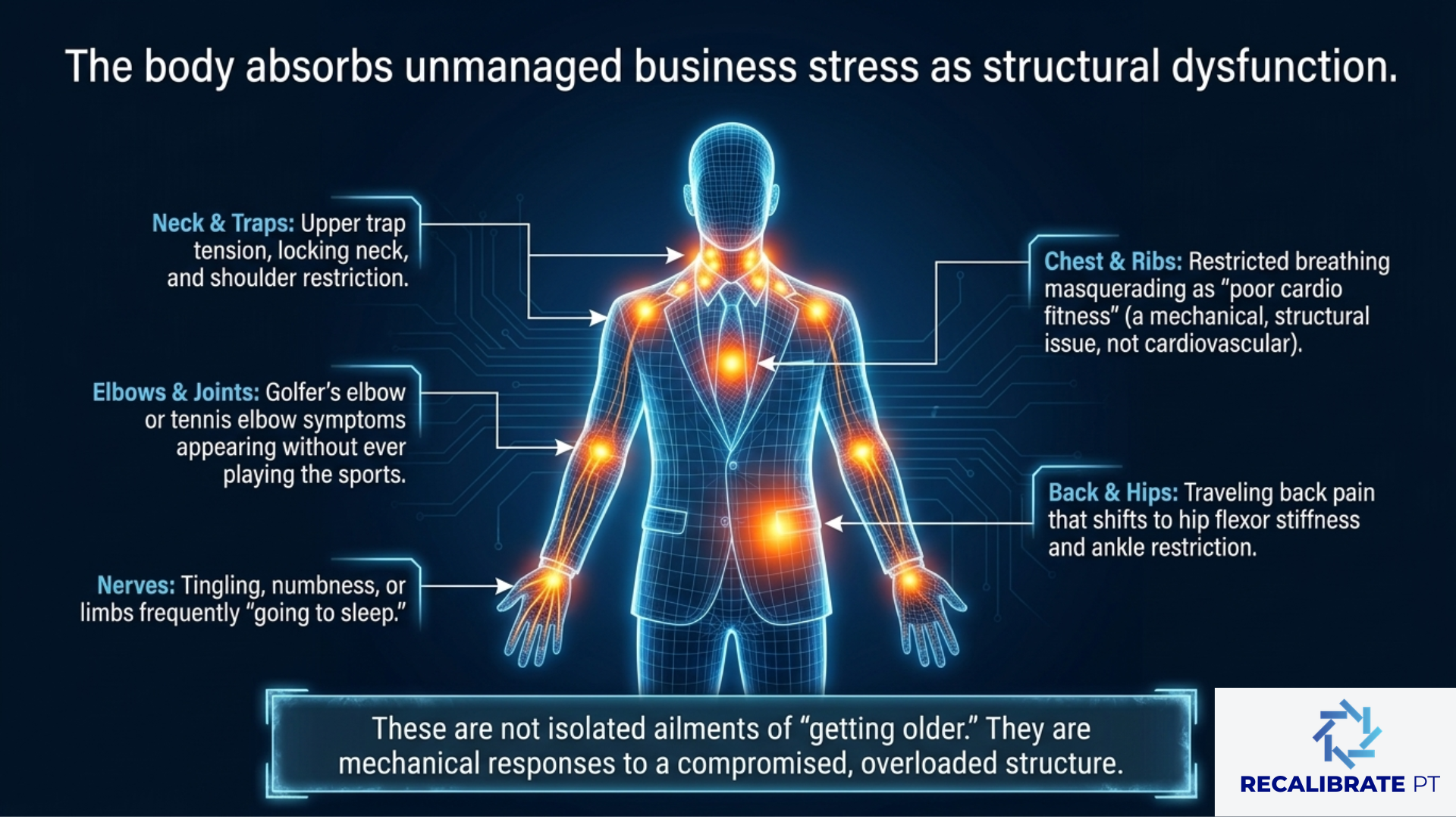
How business stress shows up in the body
When a business owner’s health is starting to affect their professional life, the signs are rarely isolated
It is not always as simple as weight gain.
Some people gain weight under stress. Others lose weight because they are under-eating, under-sleeping, dehydrated and running on caffeine, painkillers, alcohol, medication or pure adrenaline.
Physically, the typical signs include:
- chronic muscular stiffness and tightness
- recurring joint pain
- joint inflammation
- pain that seems to move around the body
- back pain that becomes neck pain
- shoulder restriction
- golfer’s elbow or tennis elbow symptoms without playing golf or tennis
- knee irritation
- hip flexor tightness
- ankle stiffness
- upper trap and neck tension
- chest tightness or restriction
- nerve symptoms such as tingling, numbness or limbs “going to sleep”
- Breathing that feels like poor cardio fitness, when the issue may be mechanical and structural
That last one matters.
A lot of people think, “I’m just unfit.”
Sometimes that is true.
But sometimes the body’s structural integrity does not support good breathing mechanics. If the rib cage, spine, pelvis, neck, and trunk are not moving well, breathing can feel restricted, even when the person does not need more cardio.
This matters because the body is not just a collection of muscles and joints.
It is connected to the nervous system.
Pain is notjust annoying. It changes how you operate.
Pain is distracting. That alone is enough to affect your working day.
But pain also changes your sense of confidence and capability. When a normal day in the office leaves you stiff, sore and feeling older than you are, it affects how you carry yourself, how you think, how you respond and how much capacity you have left for everyone else.
Pain and dysfunction can also lead to a stronger sympathetic nervous system response, which is the fight, flight or freeze side of the system.
A moderate sympathetic response can help with focus. That is normal and useful.
But when the body is under too much stress, too often, for too long, that same system becomes costly.
Research on stress and executive function shows that stress can affect prefrontal cortical processes involved in working memory, attention, inhibition and cognitive control. In plain English: chronic stress makes it harder to think clearly, regulate emotion, hold information, problem-solve and make considered decisions.
That is a serious issue for business owners.
Because when your executive function drops, you may still know what to do, but you cannot bring yourself to do it well.
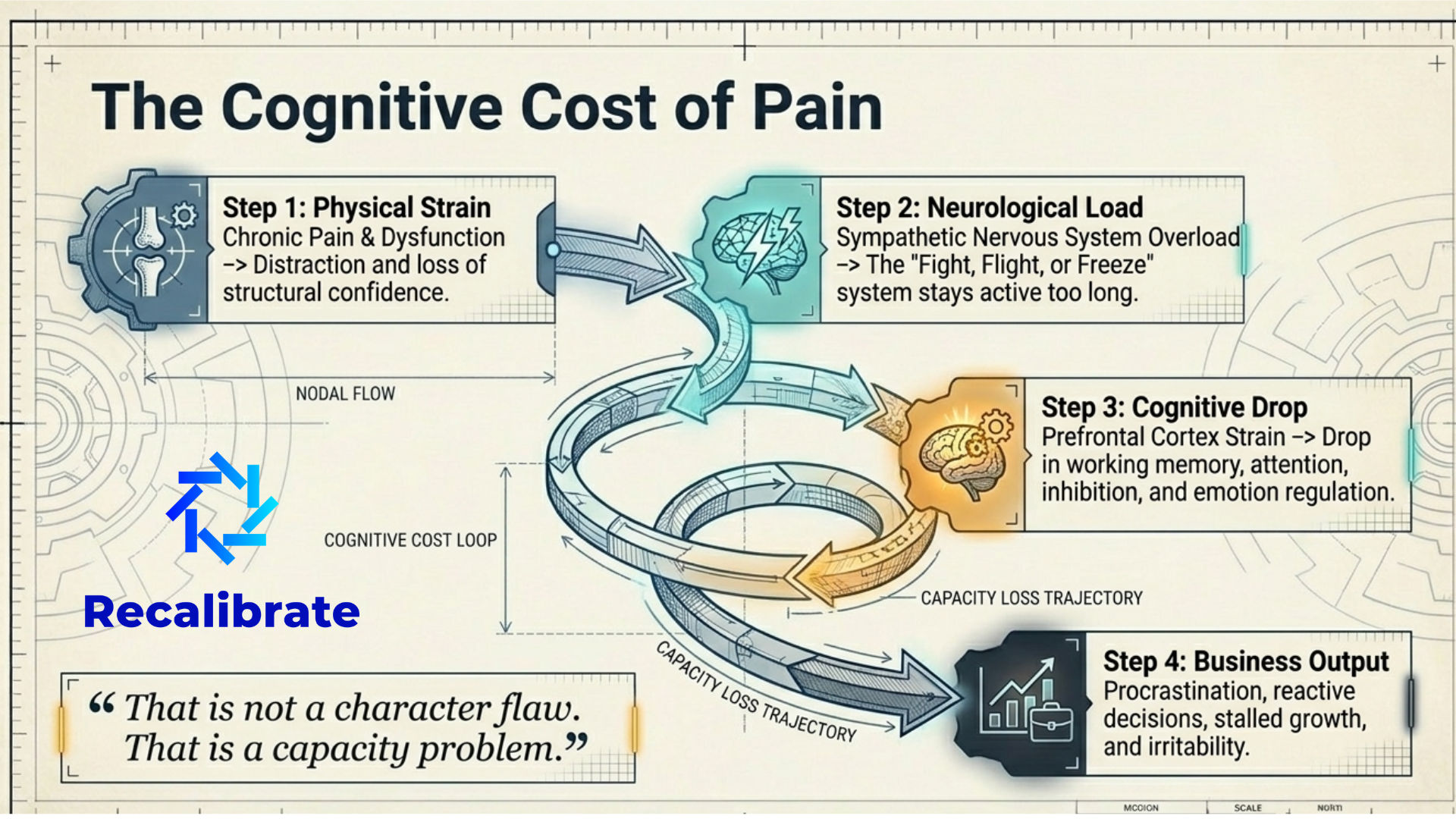
You procrastinate.
You stall.
You get reactive.
You become more irritable.
You blank out.
You avoid growth tasks.
You make decisions under pressure rather than with perspective.
That is not a character flaw.
That is a capacity problem.
Health is part ofthe leadership infrastructure.
If you are running a business, your body is not simply a personal project.
It is part of your leadership infrastructure.
When your body is constantly stiff, inflamed, sleep-deprived, under-fuelled and in pain, your business may experience the cost through:
- lower mental bandwidth
- poorer emotional management
- reduced creativity
- slower problem-solving
- shorter attention span
- lower frustration tolerance
- inconsistent follow-through
- reduced confidence
- poor delegation
- reactive decision-making
- less capacity for sales, networking and strategic advancement
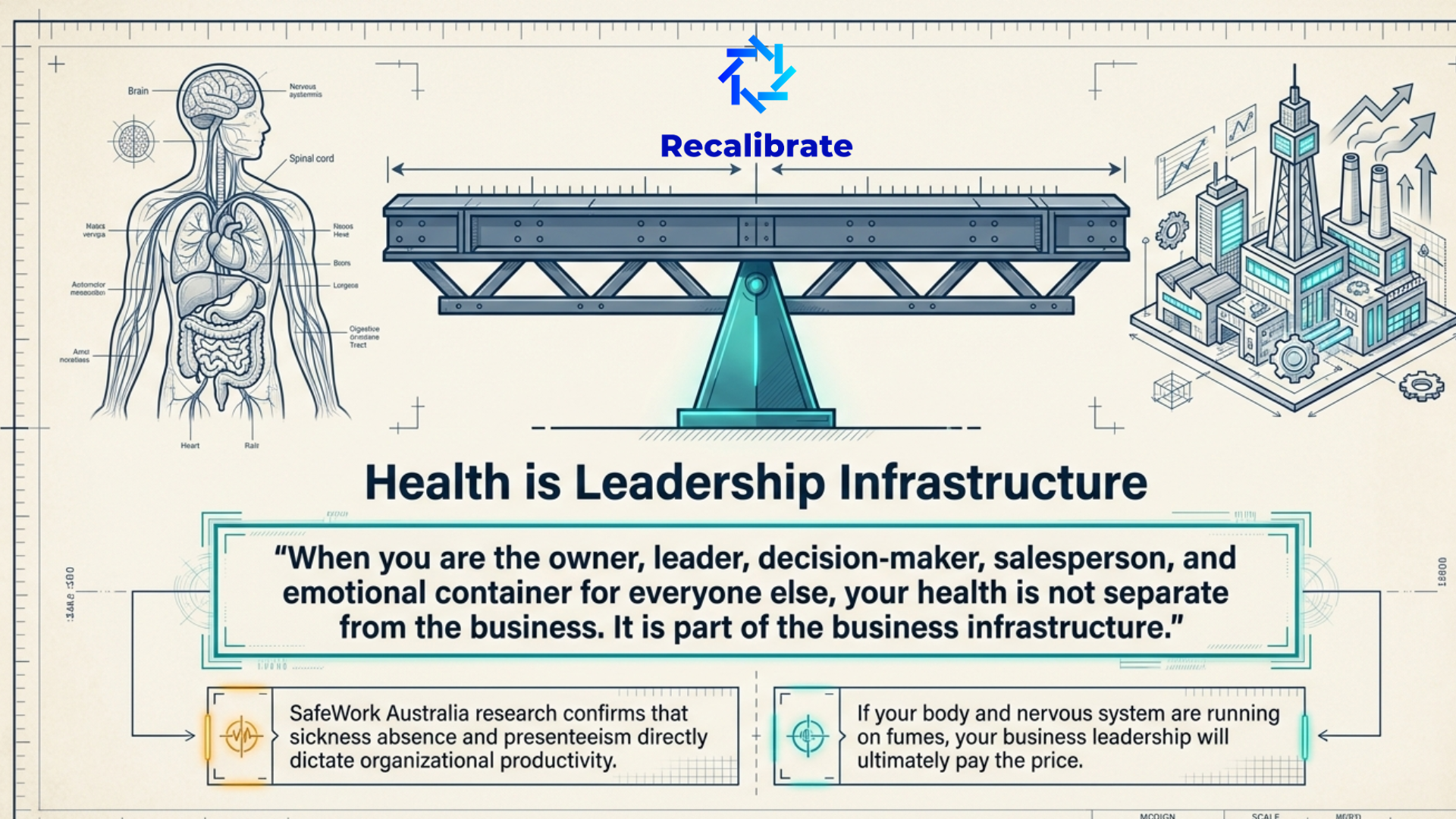
This is where business wellbeing goes beyond “self-care”.
It becomes a performance issue.
The McKinsey Health Institute also says that investing in personnel health can boost productivity and reduce presenteeism, underscoring the close link between wellbeing and organisational performance. (Jeffery et al., 2026)
For business owners, that principle becomes even sharper.
If you are the business, your physical and mental capacity directly affects it.
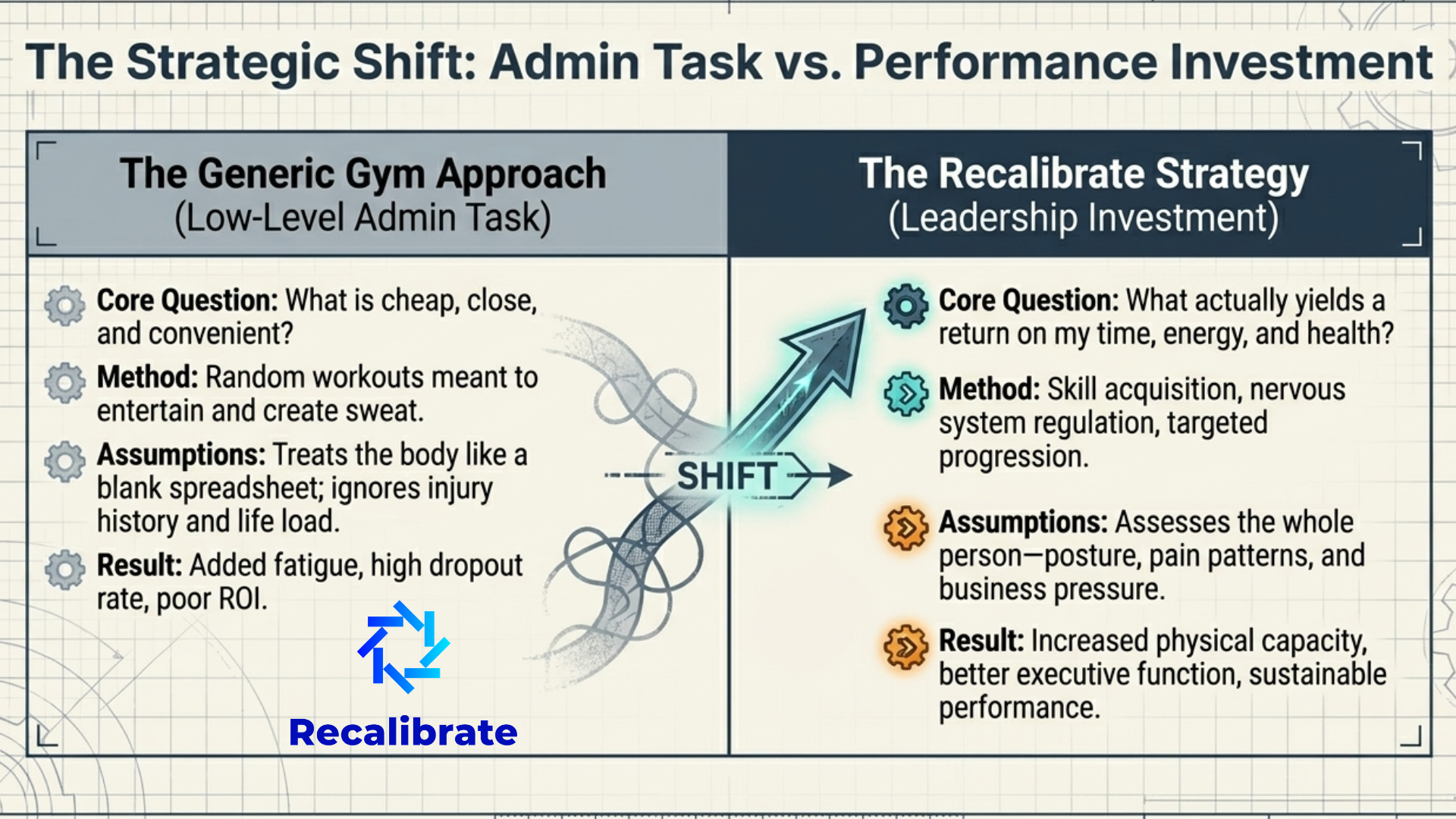
The common mistake:treating health like a low-level admin task
When business owners finally decide, “Right, I need to get my health back on track,” the most common mistake is not doing anything.
The problem is that they lack a clear strategy.
They might think:
“I just need a gym membership.”
“I just need someone to motivate me.”
“I just need to go harder.”
“I just need to lose weight.”
“I just need to do what worked ten years ago.”
“I just need the most convenient option.”
That can seem logical in the moment.
But it often fails because the investment decision is not being judged against the right return.
The question is not just:
What is cheap?
What is close?
What is convenient?
The better question is:
What will actually give me a return on my time, energy, health, confidence and financial investment, given the real demands
of my life?
A business owner would not build a company by doing random tasks that feel entertaining in the moment.
They would build it by following the right process.
Health should be no different.
For a deeper breakdown of why standard programs often miss the mark for in-demand professionals, read Strategic Health for Time-Poor Business Owners Over 40.
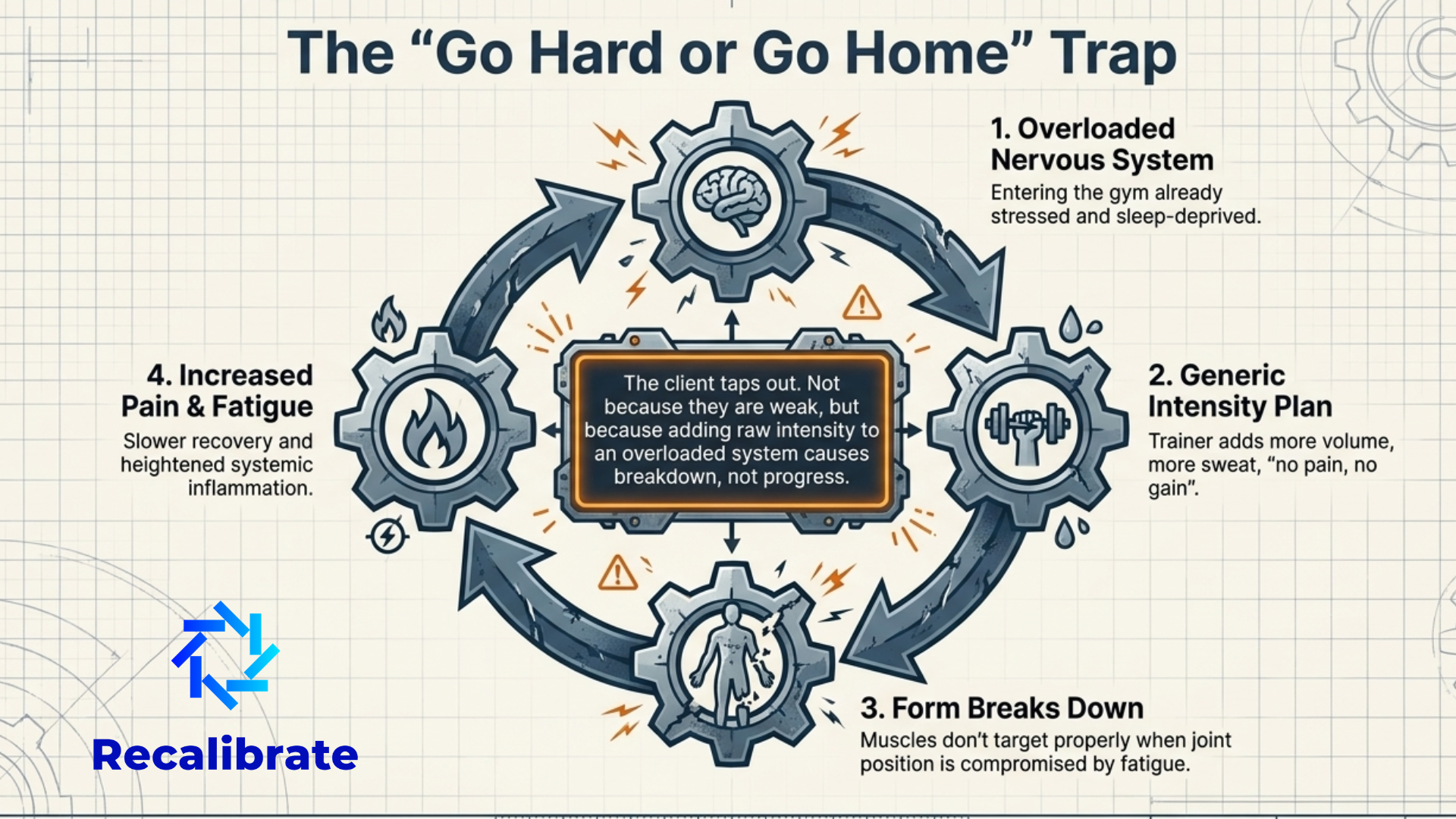
Why “go hard or go home” often sends business owners backwards.
A common pathway looks like this
A business owner walks into a gym, finds a fit-looking trainer, and says, “I need to get back into shape.”
If that trainer does not understand the person’s injury history, stress load, sleep quality, family demands, business pressure, pain patterns and current capacity, the program often becomes a generic intensity plan.
More volume.
More sweat.
More soreness.
More variety.
More “no pain, no gain”.
That might feel productive for a week or two.
But if someone is already overloaded, adding more is not always the solution.
The technique breaks down when the function is poor.
Muscles do not target properly when joint position is compromised.
Pain changes movement.
Fatigue changes posture.
Stress changes recovery.
Random workouts may entertain, but they do not build skill acquisition or meaningful progression.
Eventually, the client taps out.
Not because they are weak.
It is because the strategy was not right for them.
The real goal: reduce unnecessary stress and increase stress capacity
For business owners, the goal is not to remove all stress.
That is unrealistic.
If the business is quiet, you worry about survival.
If the business is busy, you are under pressure to deliver.
If the business is growing, demand increases.
If you have family responsibilities, they do not pause because your work diary is full.
So the goal is not to create a stress-free life.
The goal is to:
- Reduce unnecessary stress
- Carry unavoidable stress more intelligently.
- Build greater capacity, so stress costs you less.
Think of stress like carrying a heavy dumbbell.
If you carry it poorly, such as out to one side and relying only on grip and side core strength, it feels much harder.
If you bring it closer to the centre of your body, organise your posture better and use more of your structure, the same load feels easier.
That is one strategy: carry the load better.
The second strategy is to get stronger. If you train progressively, the same weight eventually feels lighter because your total capacity has increased
That is building capacity.
The third strategy is to lighten the load. Sometimes that is needed. But if you only focus on reducing load, you eventually stop adapting. You cannot remove every demand from business or life.
The smarter approach is to remove stress that is not serving a purpose, carry the necessary stress better, and build the physical and mental capacity to handle more without breaking down.
This is the Recalibrate approach.
Exercise is notjustfor the body. It supports the brain.
The right exercise program does not just change muscle, posture and body composition.
It can support cognitive performance.
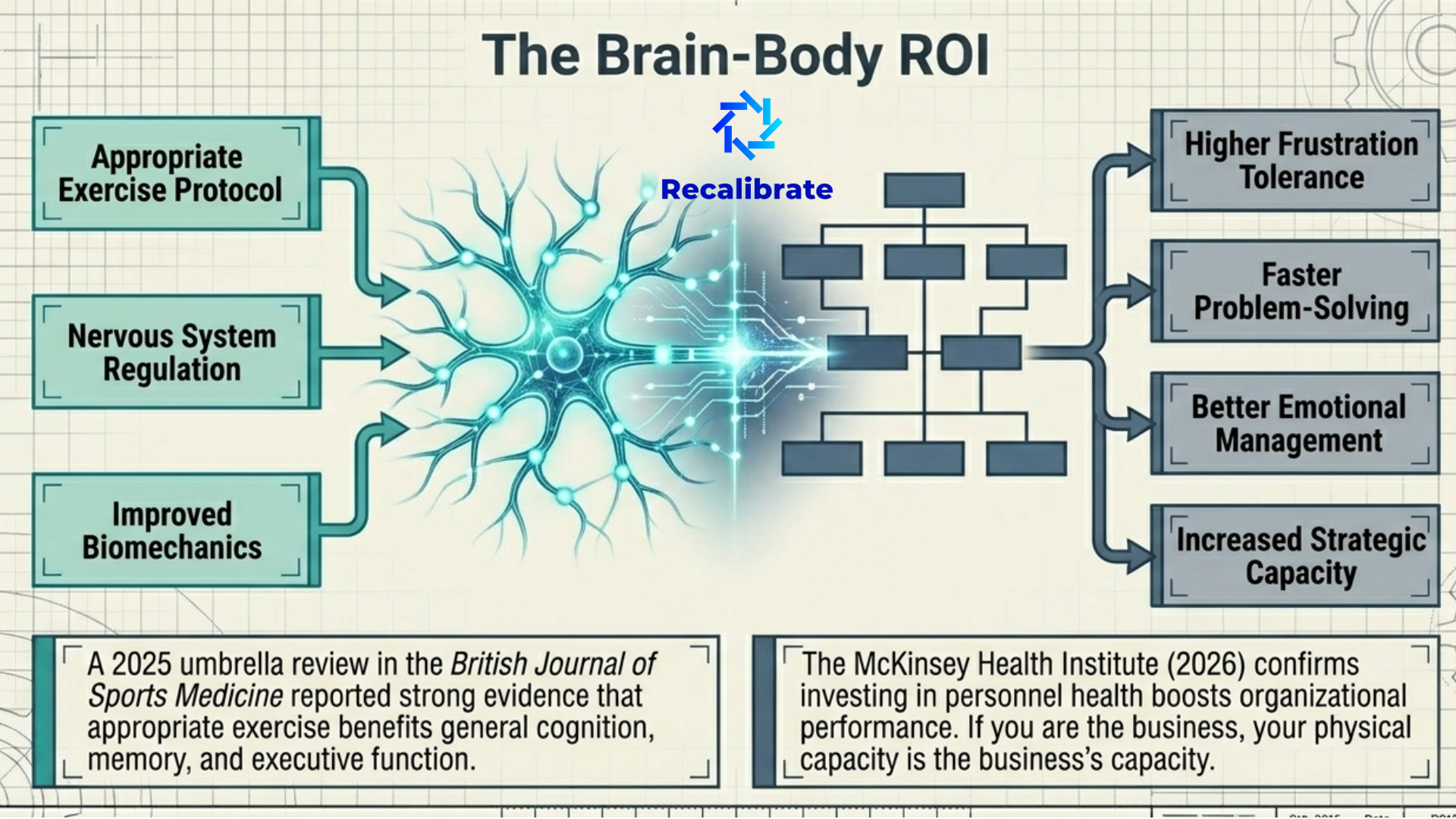
A 2025 umbrella review and meta-analysis in the British Journal of Sports Medicine reported strong evidence that exercise benefits general cognition, memory, and executive function, including from lighter-intensity activity. (Singh et al., 2025, pp. 866-876)
That matters for business owners.
The right training approach should not leave you feeling exhausted, foggy, and sore for days.
It should improve your ability to operate.
A well-designed program can help support:
- better energy
- better mood
- better posture
- better breathing
- better muscular function
- better stress regulation
- better sleep pressure
- better confidence
- better physical resilience
- better cognitive bandwidth
But the key is that the program is well-designed.
Not random.
Not excessive.
Not built around someone else’s life.
Built around yours.
Your body gives leading indicators before your brain admits there is a problem.
Business owners often realise they are burnt out after being burnt out for a while.
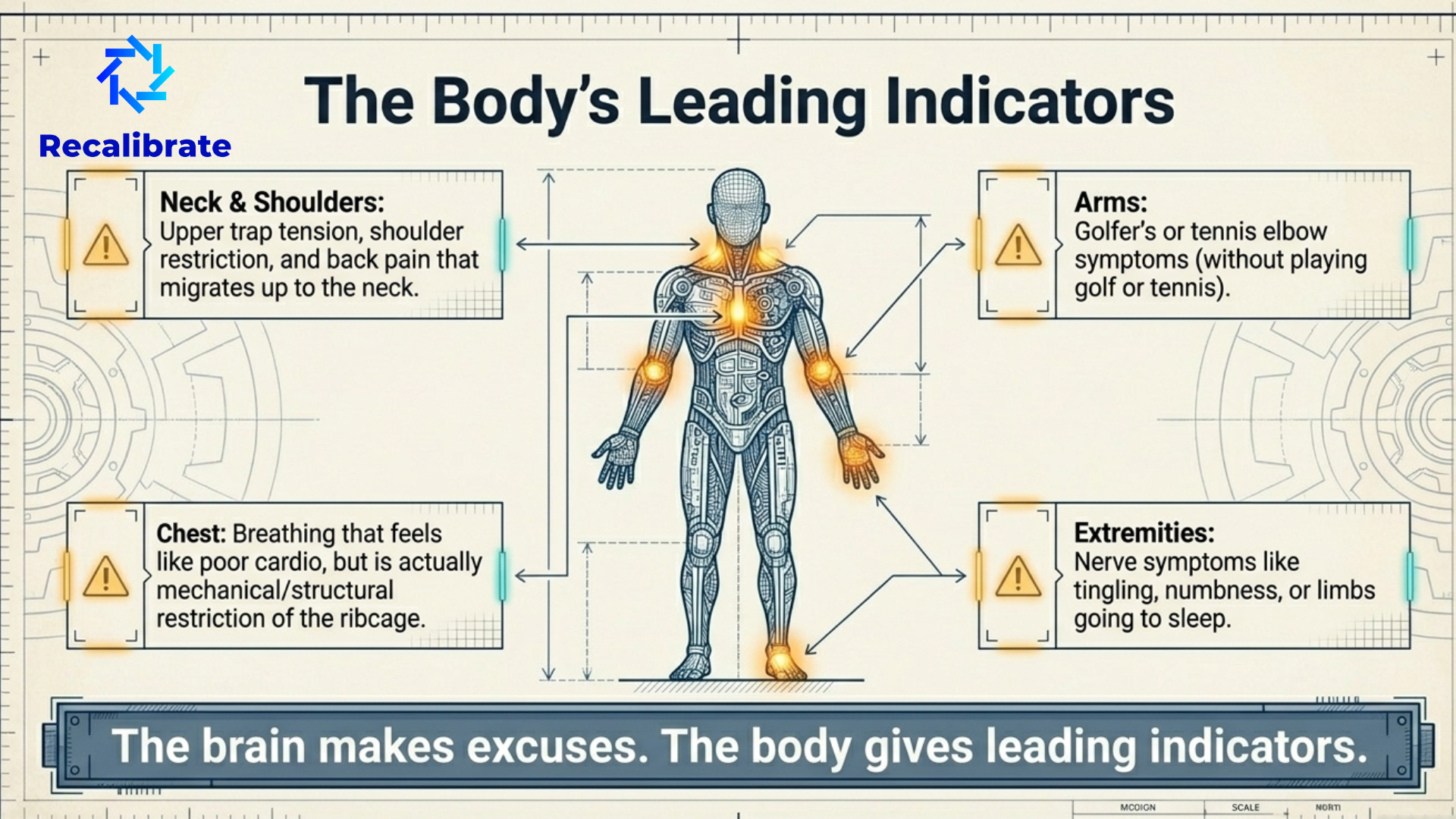
Your brain can make excuses.
“I’m fine.”
“It’s just a busy patch.”
“I’ll deal with it after this project.”
“I just need to get through this month.”
“Things will calm down soon.”
But the body usually tells the truth earlier.
Your posture changes.
Your breathing changes.
Your tissue sensitivity changes.
Your joints complain.
Your sleep quality drops.
Your recovery slows.
Your patience shortens.
Your training consistency disappears.
Your pain starts travelling from area to area
This is why I teach clients to notice physical signals before things reach a crisis point.
A business owner does not need another overwhelming list of tasks.
They need a few high-leverage checks and interventions that can be built into real life.
For example:
- checking posture in the mirror
- noticing whether they are leaning to one side
- noticing shoulder height, hand height and the space between the arms and torso
- checking key soft-tissue areas for tenderness, tightness or sensitivity
- using simple tissue work to reduce overactive areas
- using activation drills to bring underactive muscles back online
- pairing that with breathing to shift their physical and nervous system state
This is performance management.
Not crisis management.
The Recalibrate difference: start with the person, notthe workout
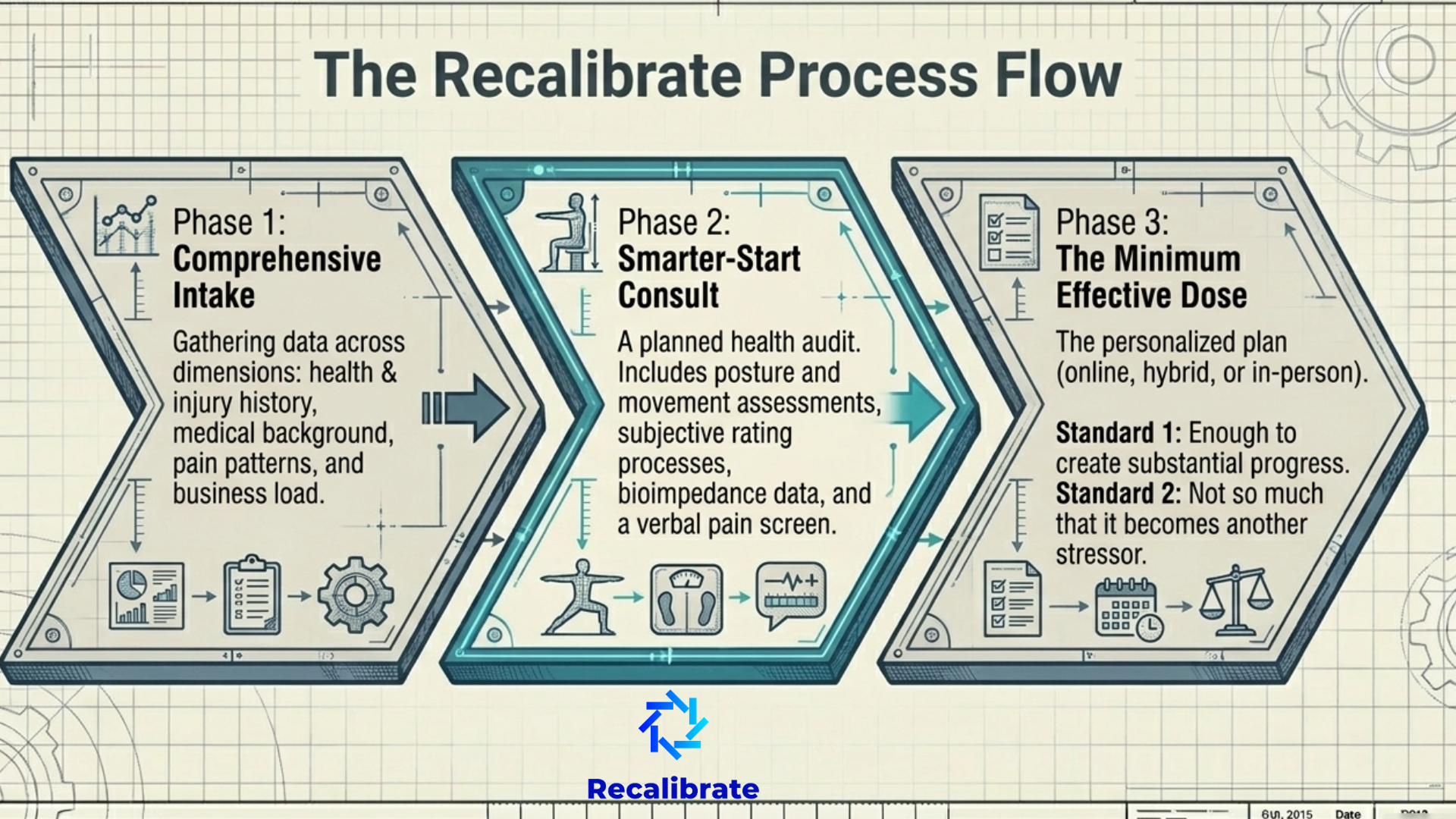
At Recalibrate, I do not start by throwing someone into a workout and wishing for the best.
I start with the person.
The goal is to gather the right information across multiple dimensions and understand the human being behind the data.
That process starts with an initial conversation and a comprehensive online intake form. This allows the client to provide meaningful detail around:
- health history
- injury history
- medical background
- pain patterns
- nutrition
- lifestyle
- training history
- current obstacles
- goals
- relevant supporting information
From there, we move into the Smarter-Start Consult process.
This is not a generic sales call.
It is a planned health audit.
The first session includes posture and movement assessments, and a subjective rating process that allows the client to feel and compare what is happening in their body.
That matters.
Because when a client experiences an immediate change from a targeted neuromuscular intervention, they understand something important:
The overall process takes time, but the strategy can start working immediately
Not through hype.
Through better information, better interpretation and better application.
Where appropriate, we also use bioimpedance data to assess metabolic health, hydration, visceral fat, and left-to-right differences in lean tissue.
We then add a verbal pain screen to ensure we have captured issues the client may have forgotten, dismissed or normalised.
After that, the client gets a simple, strategic exercise they can practise for about ten minutes each day
Then we review the findings and build a practical recommendation.
The plan may be online, hybrid or in person.
The frequency may vary.
The first phase may be very simple.
But it must meet two standards:
- It must be enough to create substantial progress.
- It must not be so much that it becomes another stressor
That is the difference between doing just enough to make progress and doing too much.
“I’ll deal with it when things calm down”
This is one of the most common things business owners tell themselves.
Here is the honest answer:
Things will never calm down.
If business is quiet, you worry.
If business is busy, you are overloaded.
If business is growing, new problems arise.
If family life is demanding, your calendar does not magically clear.
If you wait for the perfect season, you may wait for years.
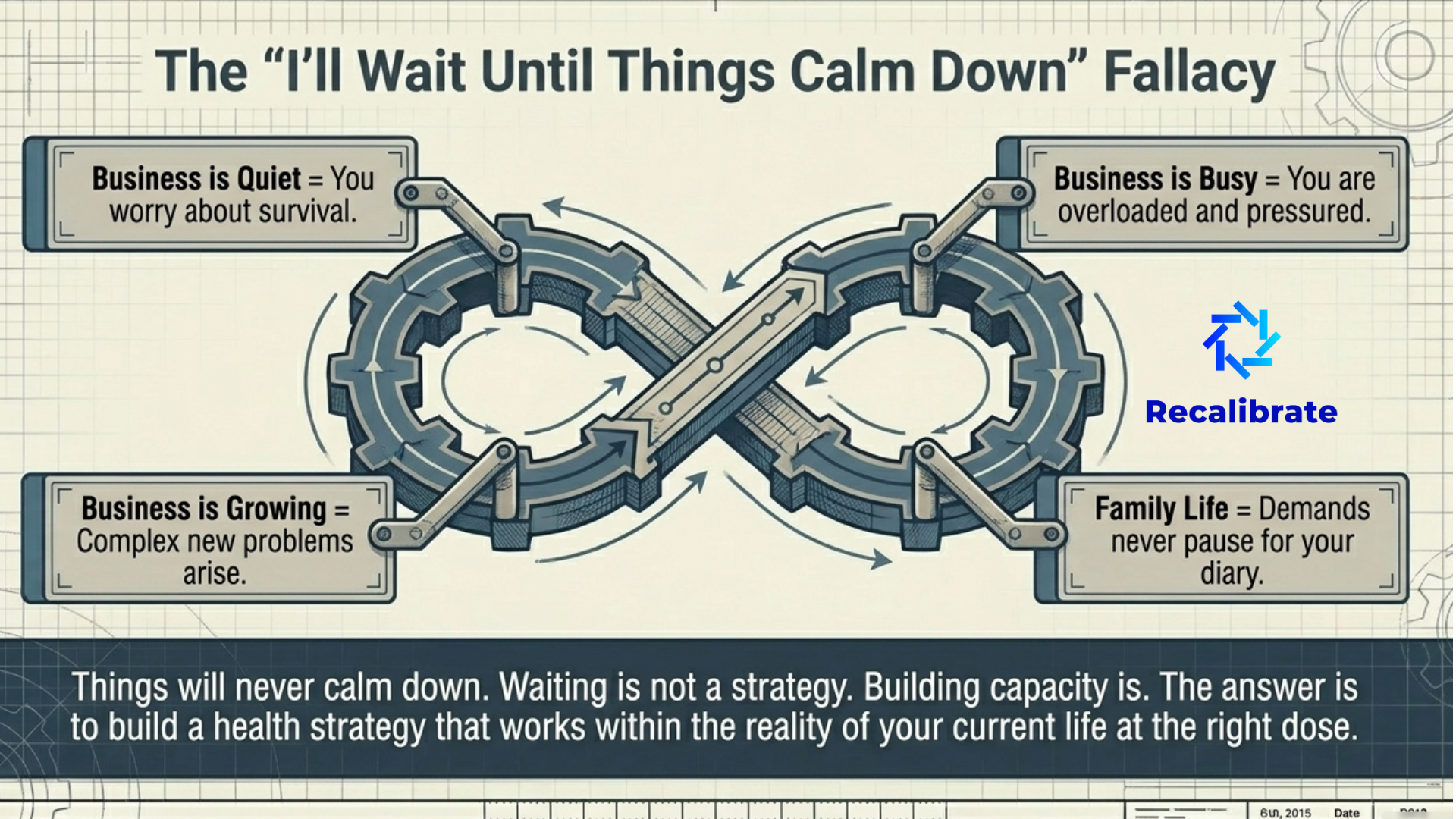
The answer is not waiting.
The answer is to build a health strategy that works within the reality of your life now.
This does not mean you have to do everything.
It means doing the right things, in the right order, at the right dose.
A strategic health plan should help you work better, not just work out.
High-demand seasons like EOFY show this clearly. In Reclaiming Your Health After EOFY, I unpack why business pressure often shows up as fatigue, stiffness, poor recovery and nervous system overload.
The same principle applies year-round.
Waiting for things to calm down is not a strategy.
Building capacity is.
Why this matters even more for people over 40, injured and time-poor
The older you get, the less margin for error you have with random training.
This does not mean you are fragile.
It means your program needs to respect your real-world state.
If you are over 40, time-poor, carrying old injuries, dealing with medical history, managing stress, leading a business and trying to keep a family life together, you do not need a program designed for someone with unlimited recovery capacity.
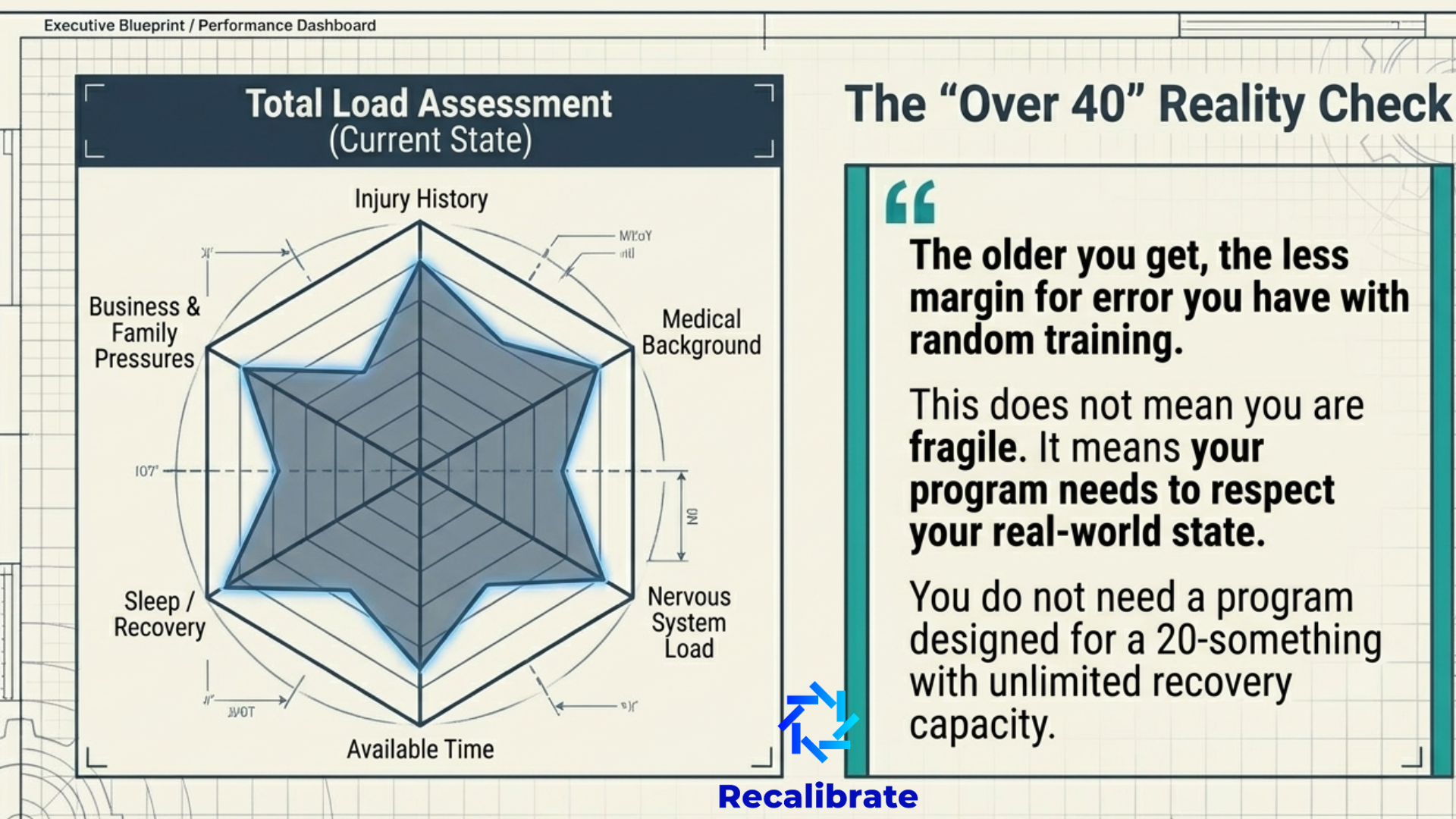
You need a plan that considers:
- your current physical function
- Your injury history
- your nervous system load
- Your available time
- your sleep and recovery
- Your nutrition reality
- your business and family pressures
- Your training preferences
- your actual capacity to execute
That is how you get traction without creating more fallout.
Business wellbeing is not separate from business success.
Healthy businesses need healthy owners.
Not perfect owners.
Not owners with six-pack abs and unlimited time.
Healthy enough to think clearly.
Healthy enough to lead well.
Healthy enough to make better decisions.
Healthy enough to handle pressure.
Healthy enough to recover.
Healthy enough to move without constant pain.
Healthy enough to keep building without burning out.
If your physical state is affecting your energy, focus, confidence, pain levels, emotional management or leadership capacity, it is no longer only a personal health issue.
It is a business performance issue.
And it deserves a smarter strategy.
Book a Smarter-Start Consult
If you are a business owner, leader, or professional and your body is starting to affect how you show up at work, it may be time to stop guessing.
The Smarter-Start Consult is designed to help you understand what is really going on, what your body is telling you, and what the most practical first phase should look like.
It can be completed:
- in person at Recalibrate Personal Training in Moorabbin
- online via video for clients across Australia and overseas
This is not about throwing more volume at an already overloaded system.
It is about building a smarter plan that fits your body, your business and your real life.
FAQs
Why do business owners commonly struggle with fitness consistency?
Many business owners are not lacking motivation. They are carrying a high total life load: business pressure, family demands, poor sleep, stress, travel, injury history and decision fatigue.
Can stress cause physical pain or tightness?
Stress can contribute to increased muscular tension, altered breathing, poorer recovery, increased sensitivity and higher nervous system load.
Pain can also increase stress, producing a cycle in which the body and nervous system feed into each other.
What is presenteeism, and why does it matter for business owners?
Presenteeism means being physically present at work but operating below capacity due to health issues, pain, fatigue, stress,
or other factors.
For business owners, this can manifest as slower decision-making, reduced focus, irritability, avoidance of growth tasks, and reduced leadership effectiveness.
Workplace research recognises presenteeism as a productivity issue, not solely a personal inconvenience. (Supervisor support,
role ambiguity and productivity associated with presenteeism: A longitudinal study, 2016, pp. 3380-3387)
Why is “go hard or go home” a poor approach for overloaded professionals?
If someone is already stressed, sore, under-recovered or injured, adding excessive training volume can increase load without improving capacity.
The smarter approach is to assess first, reduce unnecessary stress, restore function and progressively build strength and
toughness.
What makes the Recalibrate approach different?
Recalibrate starts with assessment, context and strategy.
The Smarter-Start Consult considers posture, movement, pain history, medical background, lifestyle load, relevant metabolic markers, and the client’s actual capacity before recommending a plan.
Is online coaching suitable for business owners with a pain or injury history?
Yes, when it is done properly.4
Online coaching can be effective when it includes a thorough intake, clear assessment, personalised programming, appropriate progressions and ongoing communication.
The key is not whether the coaching is online or in person.
The key is whether the strategy is appropriate
How much time does a Smarter-Start Consult or ongoing program usually require?
The Smarter-Start process starts with a comprehensive online intake form that usually takes about 20 minutes to complete.
From there, the first consult is approximately 60 minutes, followed by a 30-minute strategy session either in person or online.
Ongoing programming depends on the client’s needs, capacity and goals. For many business owners, the starting point is not a massive time commitment. It may be as simple as a few targeted minutes per day plus structured training two to three times per week.
The goal is to find the minimum effective dose: enough to create progress, without introducing another layer of overwhelm.
What are three simple steps I can take today to improve my health as a business owner?
Start with awareness before intensity.
First, check your posture in the mirror. Notice whether one shoulder sits lower, whether you tilt to one side, or whether your hands sit at different heights.
Second, take two minutes to breathe slowly through your nose, allowing your belly and lower ribs to expand rather than lifting through your chest and shoulders.
Third, go for a short walk without your phone in your hand. It does not need to be a workout. It is a simple way to shift your physical state, reduce mental noise and create a clean break between business tasks.
These actions will not replace a full strategy, but they can help you stop running your body in a purely reactive state.
How will I know if my health strategy is working
A good health strategy should create both subjective and objective progress.
Subjectively, you should notice improvements in pain levels, stiffness, energy, sleep quality, focus, emotional management, confidence and your ability to follow through.
You may feel less reactive and more capable during your working day.
Objectively, we can track relevant markers such as posture, movement quality, range of motion, strength, body composition, hydration, waist measurement, training consistency, recovery trends and pain ratings.
For business owners, there is also a practical performance question:
Are you operating better?
Are you making clearer decisions, avoiding fewer important tasks, recovering faster from big days and showing up with more consistency?
That matters.
What is the investment for the Smarter-Start Consult, and how does it compare to the potential business return?
The Smarter-Start Consult is currently offered at no charge because I prefer to do the work first, understand the person properly and prove whether I can help before recommending a paid plan.
The bigger question is return on investment.
Poor health can cost business owners through lost energy, poor decisions, reduced focus, pain-related appointments, inconsistent work output and stalled growth.
A smarter health strategy is far more than a fitness expense.
It is an investment in your capacity to lead, think, recover and perform.
Ongoing coaching investment depends on the recommended pathway, whether that is online, hybrid or in person.
Is this approach suitable for business owners with chronic conditions or significant injuries?
Yes, in many cases — but the starting point needs to be appropriate.
This approach is created specifically for people who need more than a generic workout plan. That includes business owners over 40, people with injury history, chronic pain patterns, medical considerations or reduced confidence in their body.
Where medical clearance, allied health input or a modified scope is required, that is built into the recommendation.
The goal is not to ignore complexity.
The goal is to account for it properly, so the first phase is safe, strategic and realistic.
Why not just join a gym or hire the closest trainer?
A gym membership gives you access to equipment.
It does not give you a strategy.
For an overloaded business owner, the wrong plan can cost more than doing nothing, adding pain, fatigue, frustration, and another failed attempt to the list.
The right approach starts with assessment, context and a realistic understanding of your total life load.
Convenience matters, but it should not be the only factor in decision-making.
The better question is:
What gives you the best return on your time, energy, health and long-term performance?
Sources:
- Safe Work AustraliaCosts, productivity, presenteeism, absenteeism 23 Nov 2016
- PMCPrefrontal cortex executive processes affected by stress in ...by M Girotti · 2017 ·
- McKinsey & CompanyHow employers can create a thriving workplace — 16 Jan 2025
- British Journal of Sports Medicinea systematic umbrella review and meta-meta-analysis by B Singh · 2025 ·
Share this article