The Foundations-First Framework: A Smarter Way for Over-40s to Reduce Pain, Regain Movement, and Reclaim Strength
The Foundations-First Framework is specifically designed for the "Forty+, Injured and Time-Poor" (F.I.T.) demographic. It prioritises sustainable, repeatable strength over the short-term goal of simply "looking strong."
The ultimate objective is to build physical confidence you can trust by restoring proper movement and positioning, matching training load to readiness, and sequencing healthy habits so the body can adapt without triggering injury flare-ups.
At its core, the framework is built on the principle that order, dose, and timing are critical for success, particularly for adults over 40 who may have a history of injuries.
Order matters: Training should progress sequentially from mobility to control, then capacity, and finally intensity. Skipping these stages encourages the body to rely on poor movement compensations.
Dose matters: Your ability to adapt and progress is determined by your recovery ceiling, which is influenced by stress, sleep, and daily physical load, not simply by willpower.
Timing matters: Training should match your current physical state. On low-energy or "red-flag" days, decompression work and isometric holds are often more productive than pursuing maximum volume.
Positions beat poundage: Proper alignment of the ribs, pelvis, shoulders, and hips should be established before adding load. Increasing volume on poor alignment only amplifies strain.
Pain is data: Productive muscular effort should never be confused with joint or nerve irritation. Pushing through harmful pain often compromises future training sessions.
To put these principles into practice, the framework follows an eight-step process:
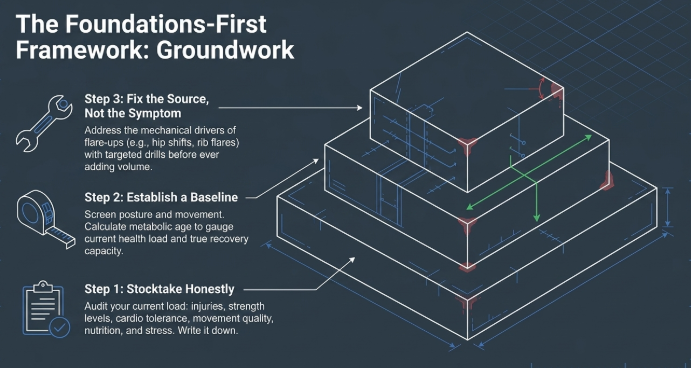
Step 1: Stocktake honestly. Conduct a realistic assessment of your injuries, strength levels, cardiovascular fitness, movement quality, nutrition, and stress levels.
Step 2: Establish a baseline. Screen posture and movement patterns, and calculate metabolic age to better understand your current health status and recovery capacity.
Step 3: Fix the source, not the symptom. Before increasing exercise volume, address the underlying drivers of flare-ups through targeted corrective strategies, such as resolving a hip shift or rib flare.
Step 4: Lift with intent. Treat lifting as practice rather than punishment. Rebuilding strength is often better achieved through 6 to 10 quality compound sets per session than through exhausting marathon circuits.
Step 5: Eat and hydrate for your goal. Support recovery and muscle repair with simple nutritional guardrails, including protein-focused meals, consistent hydration, and regular meal timing.
Step 6: Protect sleep. Prioritise both sleep quality and quantity to support recovery. A 30 to 60-minute screen-free wind-down routine before bed can help improve sleep outcomes.
Step 7: Keep it dynamic. Adjust your plan according to your readiness and the demands of different life seasons before a breakdown occurs. For example, during winter, you may extend warm-ups and choose more joint-friendly conditioning options.
Step 8: Keep showing up. Build consistency by winning the easy days, managing the hard days, and staying committed on the days in between.
To safely manage training on a day-to-day basis, the framework uses a Traffic Light Progression Guide to auto-regulate workouts according to how your body feels:
- Green: Increase the load slightly or add an additional set.
- Orange: Slow the movement down, prioritise tempo, and focus on maintaining strong positions.
- Red: Take extra rest as needed, focus on diaphragmatic breathing, and skip the workout finisher until you return to an orange or green state.
If you're over 40, managing injuries, or struggling to fit fitness into a busy schedule, the Foundations-First Framework can help you reduce pain, regain movement, and reclaim strength without relying on all-or-nothing training.
At Recalibrate Personal Training, we help people build sustainable fitness by tailoring training to their bodies, lifestyles, and recovery capacity.
Book a complimentary consultation today and discover how a smarter approach to training can help you move better, feel stronger, and stay active for the long term.
Share this article