THE RECALIBRATE RESET: The Most Important Health Statistic for Dads Isn’t What You Think
Health after 40 is about more than weight or fitness. It is about building the capacity to stay involved in family life for years to come.
Father’s Day tends to bring plenty of attention to what dads do for everyone else. But it is also a useful time to ask a different question:
How well are you looking after the person everyone else relies on?
As men move through their 30s, 40s and 50s, health starts demanding a little more attention.
Strength can decline if we stop training it. Waist circumference and metabolic health become increasingly relevant. Old aches and pains can become harder to ignore. Recovery may not feel quite as automatic as it once did.
All of those things matter.
But there is another number I think matters even more.
If even one person calls you Dad, someone still needs you.
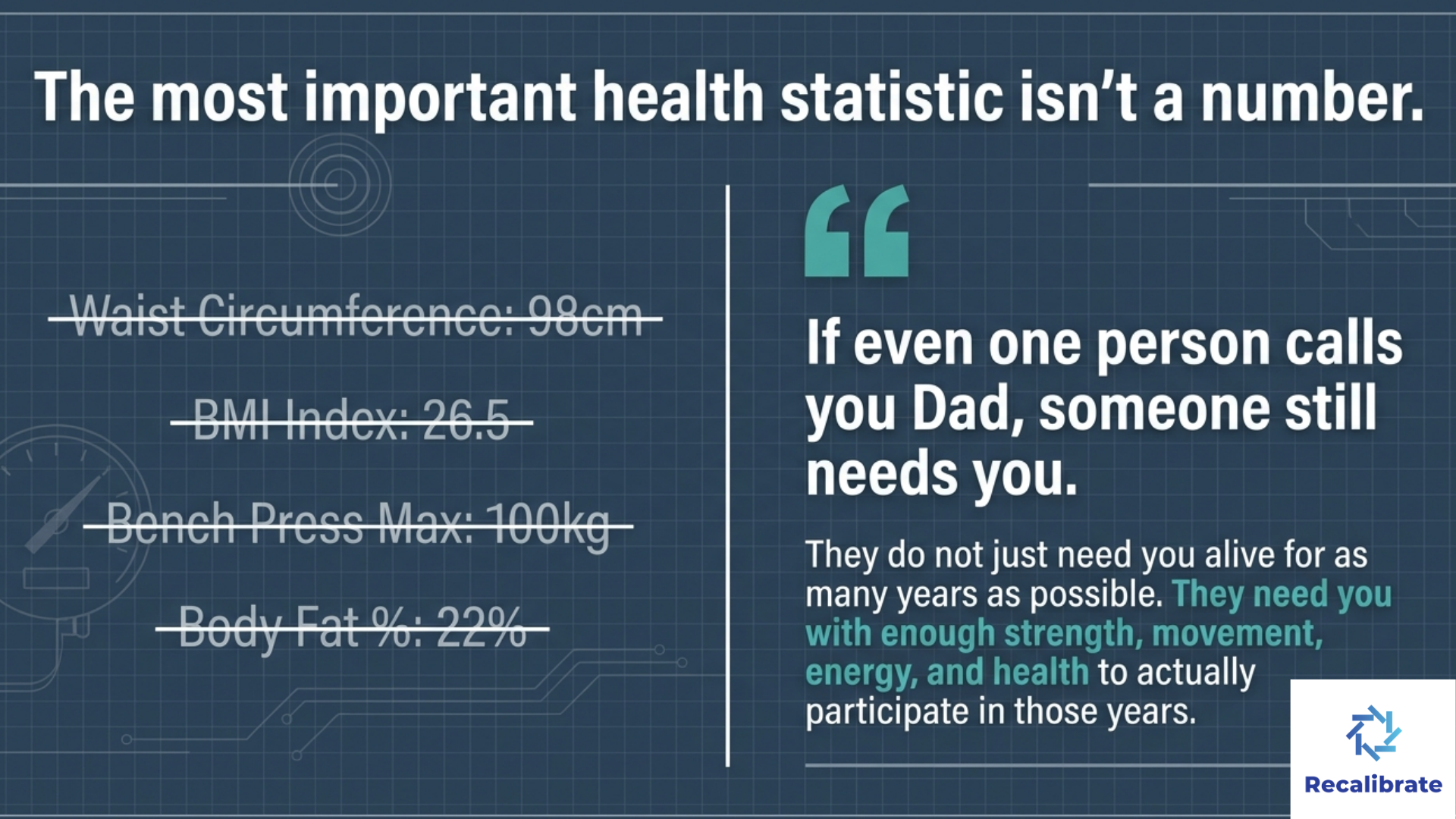
Not simply alive for as many years as possible.
They need you with enough strength, movement, energy and health to participate in those years
That changes what fitness after 40 is really about.
It stops being purely about appearance, weight or whether you can still lift what you did when you were 25.
It becomes about maintaining the capacity to keep doing the things that make up your life.
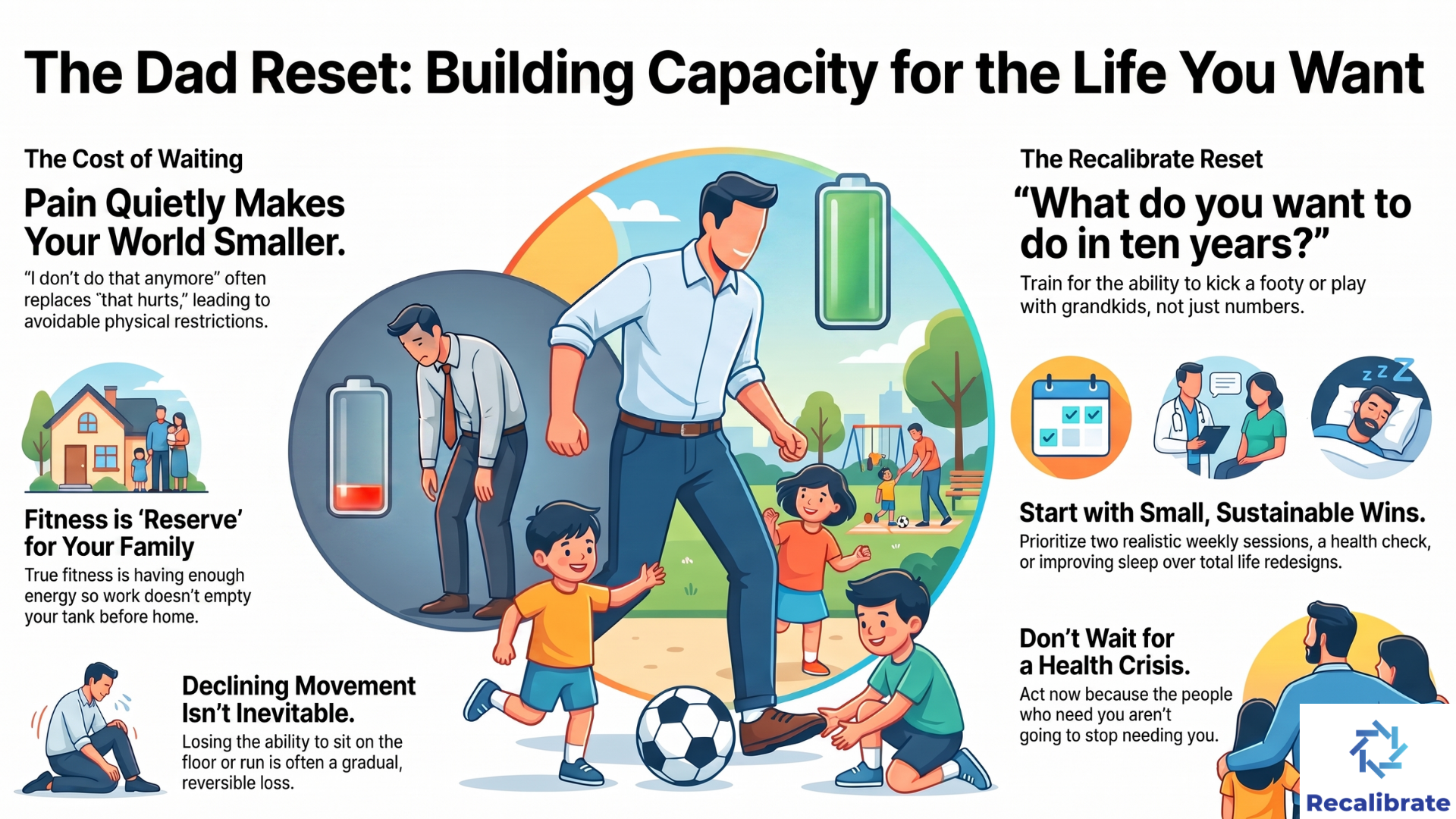
Pain Can Quietly Make Your World Smaller.
A lot of dads become very good at putting up with things.
The sore back. The knee that doesn’t quite enjoy stairs anymore. The shoulder you work around. The stiffness that seems to take longer to disappear every morning.
Initially, you adapt
But over time, ‘That hurts’ can gradually become ‘I don’t really do that anymore.’
And that is where pain can start quietly reducing your world.
You stop running. You avoid getting down on the floor. You leave certain jobs around the house to somebody else. You turn down activities because you know how your body will feel afterwards.
The objective is not to ignore pain or blindly push through it. It is to understand what can be changed before avoidance becomes your new normal.
Your kids probably don’t care whether you can bench press 100 kilograms. But they may care whether you can still kick a footy, carry something heavy, go for a long walk, get down on the floor or say yes when they ask you to join in.
Getting Older Doesn’t Have to Mean Accepting Less Movement
There is a tendency to treat declining movement as an unavoidable part of ageing.
Sometimes it happens so gradually that you barely notice it.
You stop running because of your knees. You stop sitting on the floor because getting back up is uncomfortable. You work around an old restriction for years. Eventually, you forget that those movements once felt completely normal.
The goal isn’t necessarily to move exactly as you did at 20.
The better goal is to maintain and rebuild enough movement that age does not unnecessarily decide what you can and cannot participate in.
- walking more regularly;
- rebuilding movement you’ve gradually lost;
- addressing a longstanding restriction rather than constantly working around it;
- practising getting comfortably on and off the floor;
- or modifying an exercise enough that you can begin training it again.
Keep as many physical options available to yourself as possible.
Fitness After 40 Is About Reserve
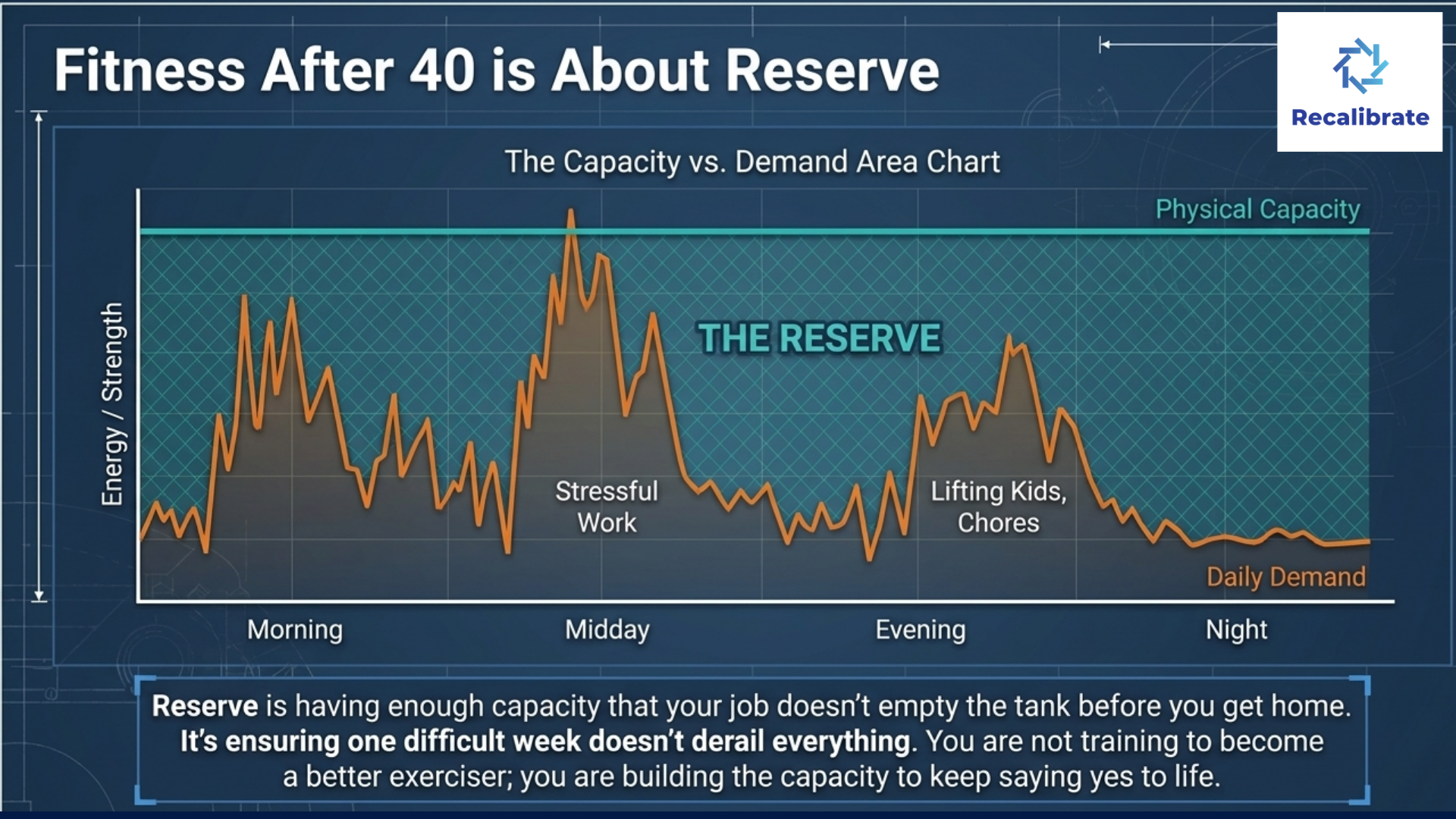
One version of fitness becomes particularly valuable when other people depend on you: reserve.
Enough strength that carrying something heavy doesn’t take everything you’ve got.
Enough cardiovascular fitness that an active day doesn’t wipe you out.
Enough physical capacity that your job doesn’t empty the tank before you get home.
Enough resilience that one difficult week doesn’t derail everything.
This is why I encourage people over 40 to think beyond ‘Am I exercising enough?’ and ask: ‘Do I have enough physical capacity for the life I want to keep living?’
That is a much more useful definition of fitness.
You are not training simply to become better at training. You are building the capacity to keep saying yes to life.
Don’t Wait for a Crisis to Make Health Important
Many of the issues that become relevant in midlife do not arrive overnight.
Reduced fitness, loss of strength, increasing waist circumference, poorer metabolic health, persistent pain and declining movement tend to accumulate.
But that also means there is an opportunity.
You can act before a crisis forces the issue.
You don’t need to become obsessive about your health. And you don’t need to redesign your life overnight.
You need to stop treating your health like something you’ll finally get around to when everyone else stops needing something from you.
Because chances are: they aren’t going to.
A Father’s Day Reset
Instead of asking, ‘Am I as fit as I used to be?’ ask: ‘Are the choices I’m making today helping me become the dad I want to be ten years from now?’
Your next step might be:
- getting the health check you’ve been postponing;
- addressing the back or knee you’ve learned to live around;
- scheduling two realistic training sessions into your week;
- improving your sleep;
- walking more often;
- making one better food choice consistently;
- or asking for professional help rather than continually promising yourself you’ll sort it out later.
You don’t have to fix everything at once
Start taking care of the person your family still needs.
And think about this:
What is something you want your body to still allow you to do with your kids - or grandkids - ten years from now?
Your answer is probably a better reason to look after yourself than any number on a fitness test.
Gary Wagner
Recalibrate Personal Training
PT for the F.I.T. - Forty+, Injured & Time-Poor
In-person in Moorabbin | Online | Hybrid
Share this article