
How to Stay Healthy With Constant Travel: A Practical Guide for the Forty-Plus, Injured and Time-Poor
Who this article is for?
This article is for adults who travel frequently for work or for long-term travel, especially those over 40, those managing previous injuries, or those trying to stay healthy while time-poor.
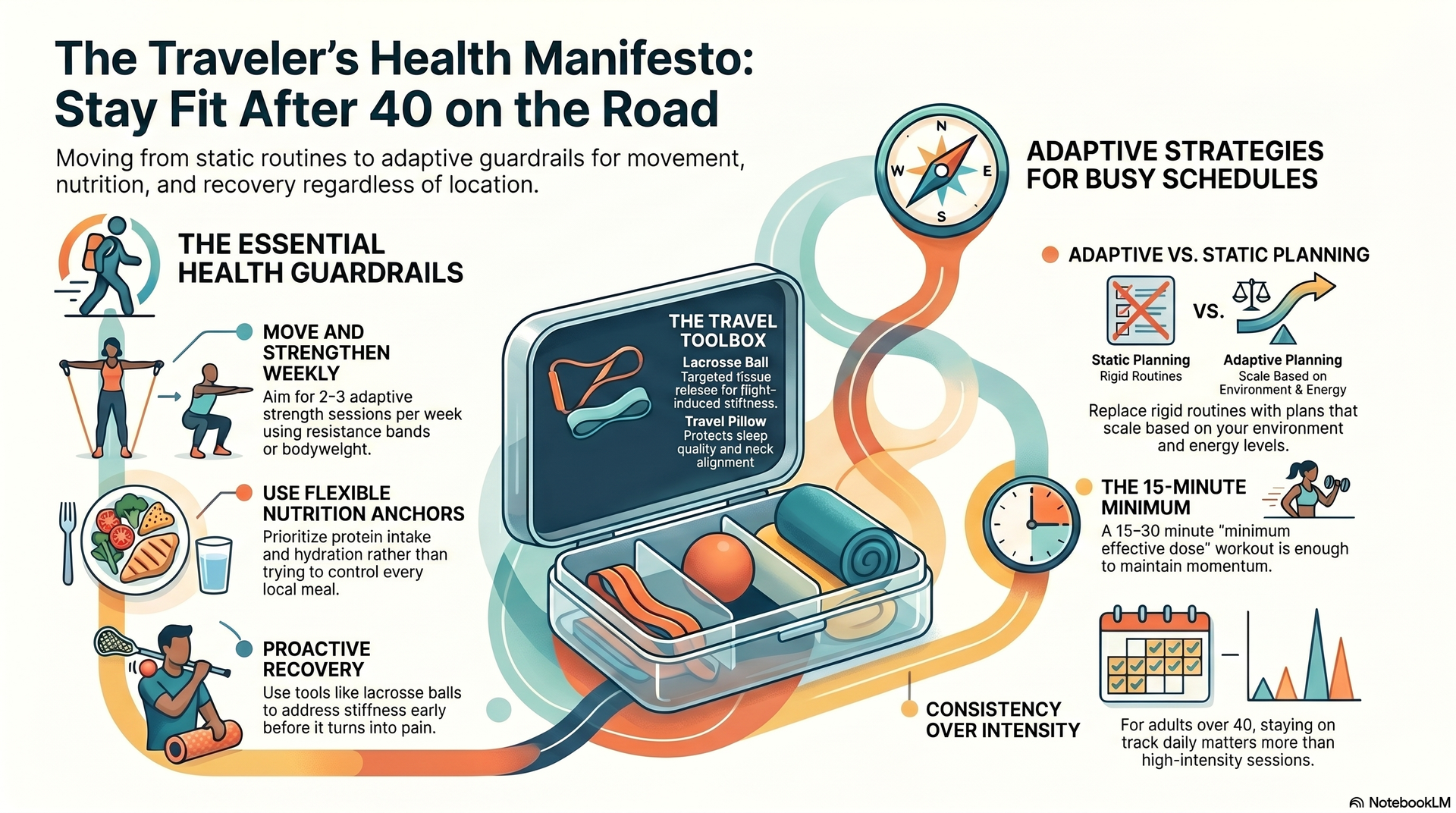
Key takeaways
- Long-term travel does not require a perfect routine, but it does require guardrails.
- Protect movement, strength training, nutrition, hydration, sleep, and recovery.
- Static plans often fail during travel; adaptive plans work better.
- Two to three strength sessions per week are enough for many travellers.
- Small tools like bands, a travel pillow, and a lacrosse ball can make a major difference.
Long-term travel can be exciting, but it can also throw your health, fitness, and routine off course very quickly.
If you often travel for work, plan extended trips or live a lifestyle away from your usual setup, it is easy to lose momentum. Your
normal gym has gone. Your food choices change. Your sleep is disrupted. Your body becomes stiff. Your time becomes
unpredictable. Suddenly, healthy habits that appeared solid at home start to fall apart.
For many people, especially those who are over 40, already managing injuries, or trying to stay healthy while time-poor, the
issue is not motivation.
The issue is that their plan is too rigid.
If you want to stay healthy while travelling long-term, you do not need a perfect routine. You need an adaptive one.
How long-term travel can derail your health and fitness
Much health and fitness advice assumes stable conditions. It assumes you have access to your normal training environment,
usual food, your own bed, a predictable routine, and enough mental bandwidth to stay on top of everything.
Long-term travel strips that away.
You may be dealing with:
- changing time zones
- long flights, drives, or train trips
- hotel rooms or Airbnbs with poor sleeping setups
- limited gym access
- unfamiliar food options
- increased social eating
- disrupted recovery
- more sitting than usual
- Repetitive strain from walking, carrying luggage, cycling, hiking, or commuting
- work stress and tight travel schedules.
That is why static plans often fail.
A static plan might look good on paper, but it usually breaks when real life changes. A proactive, adaptive plan has a much
better chance of surviving travel.
How to stay healthy while travelling: protect your guardrails
If you are wondering how to maintain your health while travelling, start here:
Protect your guardrails.
Guardrails are the key habits and systems that keep you moving in the right direction, even when life gets messy.
For most people, those guardrails include:
- regular movement
- strength training
- sensible nutrition
- hydration
- sleep protection
- recovery tools and strategies
- a way to adapt quickly when your body starts to tighten up, or your routine starts to slide
This is especially important if you are a frequent traveler, a business traveler, or someone planning long-term travel and worried about losing progress.
The goal is not to enforce perfect routines while travelling.
The goal is to ensure your important habits continue, even if the format changes.
How to exercise while travelling for work or long-term travel
A common mistake is relying on one ideal exercise setup while travelling. Delaying exercise until conditions are perfect makes your habits fragile. Protect the exercise behaviour first, then adapt your method to current resources.
For strength training, use resistance bands, adapt to available equipment, or work with an online coach who can modify your plan.
- choosing accommodation with gym access when possible
- following a training plan that can be scaled to bodyweight, bands, dumbbells, or machines
- working with an online coach who can adjust your training as your environment changes
If your plan only works in your usual gym, it is too weak for travel.
Aim for two to three strength sessions per week, adjusting volume to your trip. Increase recovery after hiking or cycling. Add daily movement and structured strength when sitting for long periods. The key is context.
Travel health tips for adults over 40
If you are over 40, travel can have a bigger impact on your body than it used to. You may notice:
- more stiffness after flights or long drives
- poorer recovery from bad sleep
- more sensitivity to unfamiliar beds and pillows
- increased joint irritation
- more difficulty “bouncing back” from a few days off track
That does not mean long-term travel is a bad idea; it means you need better systems. Some of the most effective travel health strategies for adults over 40 include:
- planning your movement before the trip begins
- keeping some form of resistance training in place
- using simple recovery tools such as bands or a lacrosse ball
- addressing stiffness early instead of waiting for pain to build
- protecting hydration
- keeping at least some daily food choices aligned with your goals
- avoiding the all-or-nothing mindset
For this group, consistency usually matters more than intensity.
How to eat healthy while travelling for work or long-term
Travel nutrition works best when you focus on practical, sustainable choices. Avoid extremes and aim for balance. A realistic strategy lets you enjoy new foods and experiences while supporting your health with smart choices. That may include:
- Taking a few useful supplements that travel easily
- Having a quality protein option available
- making sensible food choices within the local cuisine
- keeping some nutritional anchors in place rather than chasing
perfection
Depending on the person and the travel context, useful travel supplements may include:
- omega-3
- creatine
- vitamin D
- a multivitamin
- a practical protein supplement
Supplements can help fill nutritional gaps during travel, especially when meals are inconsistent or unfamiliar. This is especially useful when:
Protein intake is likely to be low. The routine is disrupted. Access to familiar foods is limited. Gut issues affect appetite or food tolerance. The travel schedule makes preparation difficult.
Avoid trying to control every meal. Instead, adopt a few simple habits to stay healthy and adapt when needed. The goal is to have enough structure that you stay aligned with your health goals without feeling trapped by them.
How to improve sleep, stiffness, and recovery while travelling
If you are travelling constantly, recovery needs its own strategy.
Many people underestimate how much poor sleep, stiffness, and travel posture affect their energy, training, and overall well being.
Planes, buses, hotel beds, different pillows, long sitting periods, and heavy luggage can all build tension and fatigue. That is why it helps to travel with a small recovery toolbox. This may include:
- a travel pillow
- a lacrosse ball or small tissue-release tool
- resistance bands for both exercise and corrective work
- a few simple posture resets or mobility drills you already know how to use
What matters most is not just having these tools, but knowing when to use them.
If you can recognise early signs that your body is tightening up, losing range, or becoming irritated, you can often correct course before it turns into a bigger problem.
This is a better strategy than waiting until you are sore, stiff, and behind.
What is the biggest mistake people make when trying to stay healthy while travelling?
The most common mistake is poor preparation.
People assume they will sort everything out after they arrive.
They will find a gym.
They will make healthy food choices.
They will sleep well if they book a decent room.
They will fit exercise in when they have time.
Sometimes that works.
Often it does not,
Travel clearly shows why reactive planning is weak planning.
If you know you will be in changing locations, with changing schedules, and with changing access to equipment, food, and recovery, then your health strategy needs to be proactive before the trip begins.
That is what makes it resilient.
Why adaptive health plans work better than static plans during travel
A static health plan looks neat, is easy to write down, and gives people the illusion of control.
But if the plan relies on perfect conditions, it is not actually robust.
An adaptive plan still gives you structure, but it also allows you to adjust when travel style, location, schedule, or physical demands change.
That means:
- Adjusting training volume based on activity level
- scaling exercises to suit equipment access
- shifting nutrition support based on the food environment
- increasing tissue work when sitting or stiffness builds up
- protecting the big rocks even if the details change
This is the difference between a plan that looks good and a plan that works
Can you improve your health while travelling long-term?
Yes, in some cases you absolutely can.
Many people assume travel automatically means decline. But with the right proactive and adaptive strategy, travel can be a time to better protect your health and sometimes even improve it.
That is especially true when you stop chasing perfection and start building systems that work in real conditions.
With the right plan, travel need not derail your health.
It can actually be an opportunity to strengthen it.
How to stay fit and healthy while travelling long-term
If you travel often for work, business, or lifestyle reasons, do not leave your health to chance.
Build your guardrails before you go.
Protect your movement by scheduling daily activity, your strength training by finding ways to do resistance work anywhere, your nutrition and hydration by prioritising sensible choices each day, and your sleep and recovery by maintaining consistent routines as much as possible. Make your plan flexible so you can adjust to changing conditions.
That is how you stay on track.
Not through perfection. Through preparation.
If you are over 40, managing injuries, time-poor, and travelling often, the answer is not a harder plan.
It is a smarter one.
This article is based on Gary Wagner’s coaching experience helping adults stay strong, mobile, and consistent through busy work schedules, injury history, and changing travel demands.
FAQs: Staying healthy while travelling long-term
How can I stay healthy while travelling long-term?
The most effective approach is to put simple guardrails in place before you leave. That includes maintaining regular movement, some form of strength training, sensible nutrition, hydration, and recovery strategies, no matter where you are travelling.
How do I keep exercising while travelling?
Focus on protecting the habit, not the perfect setup. Resistance bands, bodyweight training, hotel gyms, and adaptive programs can all work. The important thing is to keep some form of structured movement and strength work in place consistently.
How often should I strength train while travelling?
For many people, two to three strength sessions per week are enough to maintain health, muscle, and momentum while travelling. The exact amount depends on the type of travel and the level of physical activity for the rest of your trip.
What should I pack to stay healthy while travelling?
Useful travel health items may include a resistance band kit, a travel pillow, a small tissue-release tool such as a lacrosse ball, hydration support, and simple supplements that match your needs and goals.
What are the best supplements for travel?
This depends on the person, but common practical options include omega-3s, creatine, vitamin D, a multivitamin, and a protein supplement. These can help support consistency when food quality, protein intake, or routine becomes harder to manage.
How do I eat well while travelling without becoming obsessive?
Use flexible nutrition guardrails rather than strict rules. Enjoy local food, but keep some daily anchors in place, such as adequate protein, hydration, and a few better default choices. The aim is to stay aligned with your goals, not to control every meal.
Why does travel make me so stiff?
Long flights, long drives, poor sleep, unfamiliar mattresses, time in transit, and reduced movement can all increase stiffness. Travel can also exaggerate existing movement issues, posture habits, and old injuries.
How can I reduce stiffness while travelling?
Regular movement, simple tissue work, posture resets, hydration, and a few corrective or activation drills can help reduce stiffness. The earlier you respond to tightening or restriction, the easier it usually is to manage.
Is it possible to improve my health while travelling?
Yes. With the right proactive and adaptive plan, it is possible not only to maintain your health while travelling, but in some cases to improve it. The key is having systems that work in real-world conditions rather than relying on perfect routines.
What is the biggest mistake people make with travel health?
The biggest mistake is being reactive instead of proactive. Many people assume they will “figure it out” once they arrive, but that often leads to missed training, poor food choices, disrupted sleep, and unnecessary physical decline.
What specific strategies do you recommend for managing existing injuries while travelling?
If you already have an injury, travel is not the time to wing it.
The key is to have a proactive plan that protects the injured area without making you fragile or overly restricted. That usually means keeping some form of appropriate strength work in place, packing simple tools that travel easily, like resistance bands and a small tissue-release tool, and knowing the early signs that your body is starting to tighten up or compensate.
You also want to think ahead about environments that may aggravate the situation. Long flights, poor pillows, soft mattresses, long walks with luggage, or repeated sitting can all stir up old issues. If you can anticipate that and have a few corrective drills, posture resets, or movement options ready, you are far less likely to get caught reacting once the pain is already high.
For some people, it is also worth having access to coaching support or an adaptive program that can be adjusted as locations, equipment, and symptoms change.
Time Constraints · How can I fit these health habits into a packed business travel schedule with little free time?
Do this by dropping the “ideal” plan and protecting the big rocks.
A packed business travel schedule usually will not support long workouts, perfect meal prep, or elaborate recovery rituals. That is fine. You do not need a perfect plan, but one that survives pressure.
That might mean:
- two to three short strength sessions per week
- daily movement targets built around your actual itinerary
- a few nutrition guardrails rather than a full diet overhaul
- hydration as a non-negotiable
- Quick recovery work in short bursts
The point is not to find extra hours, but to make sure the essentials still happen in a smaller, more adaptable format. In most
cases, steadiness with a minimum effective dose beats waiting for the perfect time that never comes.
Practical Examples · Can you provide sample daily routines or quick workouts suitable for hotel rooms or airports?
Yes. The exact structure should depend on the kind of travel and what your body needs, but a realistic day might look like this:
Busy business travel day
- A short walk and a posture reset in the morning.
- Protein-focused breakfast or first meal
- Movement breaks through the day, especially after long sitting.
- 15 to 25-minute hotel-room strength session using bands or bodyweight
- Quick tissue work and mobility reset in the evening
- Hydration and a few sensible food anchors across the day
Airport or transit day
- Walk where possible between gates or stops.
- Use standing time instead of sitting the whole time.
- Do a few simple movements of the calves, hips, thorax, and shoulders.
- Stay on top of hydration.
- Use a neck pillow or support if you are sleeping seated.
- Do a short reset session once you arrive.
Simple hotel room workout
- Squat or split squat variation
- Push-up or band press variation
- Row or pulldown variation with bands
- Hip hinge or glute bridge variation
- Core or posture drill
- Optional tissue work at the end
That can be done in 15 to 30 minutes and still provide enough stimulus to maintain strength, movement quality, and momentum
Supplements · Are there any safety or legal considerations for carrying supplements internationally?
Yes. This is one area where people should be sensible.
From a practical standpoint, choose supplements that are useful, basic, and low-fuss. Things like omega-3s, creatine, vitamin D, a multivitamin, or protein can be helpful, but you still need to check whether there are any restrictions in the countries you are entering.
The safest approach is to:
- Keep supplements in their original, clearly labelled packaging where possible.
- Check import rules for the destination country before you fly.
- Be cautious with powders, capsules, and anything that could attract extra scrutiny.
- Avoid carrying anything unnecessary or questionable.
- Make sure what you are taking is appropriate for your own health situation.
So yes, supplements can be a very practical part of travel health, but they should be chosen carefully and carried responsibly.
Recovery Tools · Which recovery tools are most travel-friendly and effective for frequent flyers?
The best recovery tools are small, light, and genuinely useful.
For most frequent flyers, I would lean toward:
- a travel pillow for neck support
- a lacrosse ball or compact tissue-release too
- a resistance band kit that can double for strength work and corrective work
- hydration support if appropriate for the trip
- a simple movement or posture reset routine you already know how to use
You do not need to carry half a clinic in your luggage. You need a compact toolbox that helps you reduce stiffness, improve movement, and stay ahead of the physical build-up that comes with travel.
The biggest win is not owning the tools. It is knowing how and when to use them before the body gets too far behind
If you are Forty-Plus, Injured, and Time-Poor, and you travel regularly for work or business, I help people build practical training, recovery, and wellness strategies they can maintain across changing locations, schedules, and environments.
Book a consult with Recalibrate, and let’s build a plan that works in real life, not just on paper.
By Gary Wagner, Founder of Recalibrate Personal Training
Online Personal Trainer for the Forty-Plus, Injured and Time-Poor
Published 18 May 2026 · Last reviewed 18 May 2026
About the author
Gary Wagner is the founder of Recalibrate Personal Training in Melbourne and an online personal trainer for Forty-Plus, Injured, and Time-Poor adults.
With more than 20 years in the fitness industry, he helps clients reduce pain, build strength, and create realistic health and wellness strategies that work in real life — including during frequent travel and disrupted routines
Share this article